
BUILT FOR DUTCH GROUND. SPECIFIED FOR CONTROL.
Engineering Pipes & Inclinometer Casings Netherlands
GEOLUR supplies PVC/PVC-U monitoring pipes, ABS inclinometer casings, PE/HDPE engineering pipes and custom perforated systems for groundwater, dewatering and geotechnical monitoring projects across the Netherlands.
Engineering Pipes for the Netherlands
Pipe systems for a country where ground and groundwater matter.
Dutch infrastructure is built in a delta with soft soils, high groundwater and a dense network of roads, railways, tunnels, dikes, quay walls and urban assets. GEOLUR focuses on the pipe components used to observe or control those conditions: monitoring-well pipe, inclinometer casing, well casing and project-specific perforated pipe.
Monitoring wells and piezometric access
PVC/PVC-U and selected HDPE systems can form plain and screened sections for groundwater-level observation, environmental monitoring and other project-specific wells.
Inclinometer casing for movement profiles
Grooved ABS casing provides the physical guide path for compatible inclinometer probes used around excavations, embankments, slopes, retaining structures and other ground-movement applications.
Dewatering, recharge and relief wells
PE/HDPE, PVC/PVC-U and custom screened sections can be reviewed for pumping, recharge or relief-well duties where the approved design defines the required material and geometry.
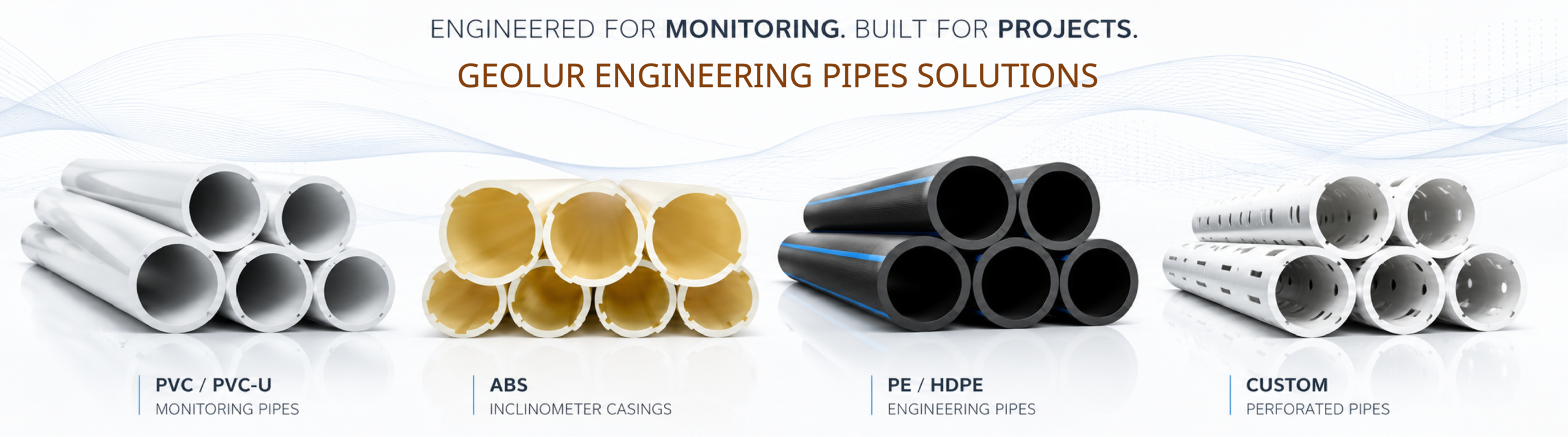
Core Product Families
Four pipe families, four different engineering functions.
Dutch projects often combine groundwater observation, deformation monitoring and groundwater control. GEOLUR keeps these functions separate so procurement teams can specify the right pipe for the job rather than treating every polymer tube as interchangeable.
Monitoring & Well Pipes
For water standpipes, open standpipe piezometers, groundwater monitoring wells, recharge wells and selected pumping or dewatering installations.
Inclinometer Casings
Grooved casing for borehole and horizontal inclinometers, retaining structures, embankments, tunnels, excavations and other movement-monitoring installations.
Engineering Well Pipes
For selected deep dewatering, recharge, relief, pumping, environmental and coastal applications where the project specification calls for PE or HDPE.
Perforated Pipe Systems
Project-specific slots, holes, spacing, screened lengths and patterns for groundwater, drainage, recharge, abstraction or other engineered hydraulic interfaces.
Dutch Ground Conditions
Soft soil and controlled groundwater shape the specification.
Deltares notes that peat and clay layers in the Netherlands can compress substantially under embankments, site preparation and other loading. Long consolidation periods, groundwater-level changes and spatial variation make measurement and groundwater control part of day-to-day civil engineering rather than an occasional specialist issue.
Peat & Clay Settlement
Soft Dutch soils can continue to settle after construction. Embankments, roads, rail and public space therefore benefit from monitoring layouts that distinguish surface effects from movement at depth.
Groundwater-Level Sensitivity
Lowering groundwater can accelerate consolidation or expose vulnerable timber foundations. High groundwater can create uplift and construction constraints. Monitoring-well design must reflect the actual hydrogeological question.
Dense Existing Infrastructure
Tunnels, quay walls, railways, utilities, buildings and flood defences often sit close to new works. Deformation and groundwater changes can therefore have consequences beyond the project boundary.
Engineering context: Deltares — D-Settlement and Deltares — Foundations and land subsidence.
Netherlands Applications
Where these pipe systems fit Dutch civil engineering.
The same project can require several pipe families at once. A tunnel excavation may need inclinometers outside the retaining system, monitoring wells around the works and separate pumping or recharge wells. The correct specification starts by separating those functions.
Dikes & Embankments
Inclinometer casing can support deformation monitoring, while groundwater and pore-pressure observation may require separate monitoring wells or standpipes.
Road & Rail Infrastructure
Soft-ground settlement, staged widening, temporary works and adjacent-asset protection create recurring demand for deformation and groundwater monitoring.
Tunnels & Deep Excavations
Retaining-wall movement, ground settlement, groundwater drawdown and uplift pressure may all require separate monitoring or well components.
Quay Walls & Foundations
Groundwater variation and local ground movement can affect existing piles, masonry, quay structures and utilities, particularly in older urban areas.
Groundwater Monitoring
Monitoring wells may support groundwater-level, groundwater-quality and hydrogeological programmes. Material and screen configuration should match the intended measurement or sampling objective.
Dewatering & Recharge
Temporary construction may require abstraction, reinfiltration or pressure relief. Pipe material, diameter, connections and screened interval are design variables, not catalogue defaults.
Material & System Selection
Choose the pipe around the measurement or hydraulic duty.
Royal Eijkelkamp, based in the Netherlands, separates monitoring-well systems into plain pipe, filter pipe, filter material, seals and protection. Boode similarly treats screen, casing, connection and application as a complete well system. GEOLUR follows the same engineering principle: one material property should never decide the whole specification.
| Product Family | First Use to Consider | Key Procurement Questions | Do Not Assume |
|---|---|---|---|
| PVC / PVC-U | Monitoring wells, standpipes, piezometric access, selected well casing and screen | Diameter, plain/screened length, slot requirement, connection, groundwater chemistry, sampling objective | That every PVC formulation or screen geometry is suitable for every groundwater-quality programme |
| ABS Inclinometer Casing | Borehole or horizontal movement monitoring | Probe compatibility, casing size, groove geometry, joint, installation depth, expected deformation | That ordinary plain plastic pipe can replace purpose-designed grooved casing |
| PE / HDPE | Selected monitoring, pumping, recharge, relief and aggressive-environment well applications | Material grade, diameter, wall/SDR if specified, joining method, chemical environment, depth and hydraulic duty | That HDPE is automatically the best material for every groundwater sampling or deep-well application |
| Custom Perforated Pipe | Project-specific screened or hydraulic intake zones | Opening type, slot/hole size, rows, spacing, open area, screened interval, base pipe and structural requirement | That maximising open area is always better than balancing hydraulic and mechanical requirements |
Groundwater Monitoring in the Netherlands
The monitoring pipe sits inside a formal groundwater-data chain.
The Dutch Basisregistratie Ondergrond (BRO) maintains dedicated registration objects for groundwater monitoring wells, monitoring networks, groundwater levels and groundwater composition. That national data structure reinforces a practical point: the physical monitoring well must be built around the data objective and remain identifiable and usable over time.
Monitoring-Well Construction
Plain pipe, filter pipe, caps, seals and protection should form one controlled installation. The screened interval should correspond to the groundwater zone that the project intends to observe.
Material Choice Matters
For groundwater quality, adsorption, diffusion and chemical compatibility can matter as much as strength. The material should be selected against the analytes and groundwater environment rather than by habit.
Protect Long-Term Access
Monitoring programmes can extend beyond construction. Tops, covers, identification and protection should therefore be planned alongside the underground pipe configuration.
Netherlands reference: BRO — Groundwater monitoring.
Verified Netherlands Case References
Dutch projects show why groundwater and deformation are monitored together.
The cases below are independent engineering references. They are included to explain Dutch project conditions and monitoring logic; GEOLUR does not claim to have supplied these projects.
Dewatering with reinfiltration and extensive monitoring
Rijkswaterstaat described phased dewatering for the A9 tunnel works, with part of the abstracted water returned to the ground. The project used monitoring wells both around and within the work area to track groundwater response.
Groundwater pressure as a structural risk
Repair works were planned to minimise groundwater lowering because of potential effects on surrounding buildings. Rijkswaterstaat also reported that monitoring allowed deformation during the works to be recognised and acted upon quickly.
Monitoring wells retained for predictive maintenance
During technical investigations, Rijkswaterstaat installed monitoring pipes to measure groundwater levels inside and outside the tunnel and stated that the wells would remain in place after renovation to support current groundwater information.
What do these cases mean for pipe procurement?
Why is movement monitoring also relevant?
Specification & QA/QC
Make the quoted pipe traceable to the project requirement.
Dutch engineering procurement is specification-led. A useful RFQ should identify which requirements are mandatory, which are preferences and which remain to be confirmed. GEOLUR can then review the requested supply configuration without inventing missing project criteria.
- Material and material grade
- Outside / inside diameter where relevant
- Wall or SDR requirement if specified
- Individual pipe length
- Total installation depth
- Connection or coupling type
- Plain and screened intervals
- Slot or perforation geometry
- Inclinometer probe compatibility
- Pump compatibility where applicable
- Groundwater chemistry / sampling objective
- Expected movement where applicable
- Required standard or specification clause
- Required certificates / inspection records
- Packaging requirement
- Delivery location and programme
Netherlands Project Supply
Project-based supply for Dutch contractors, consultants and specialists.
GEOLUR supports enquiries for projects across the Netherlands. Supply is coordinated against the confirmed specification, quantity, packing, programme and delivery destination rather than presented as an unverified local-stock promise.
Randstad & Western Netherlands
Amsterdam, Rotterdam, The Hague, Utrecht and surrounding project areas with dense urban construction, tunnels, quay walls, railways, groundwater and foundation constraints.
National Infrastructure
Road, rail, dike, waterway, industrial and environmental projects where engineered monitoring or groundwater pipe systems are specified.
Custom Project Packages
Mixed schedules can be reviewed where one project requires different pipe families, diameters, screened sections, connections or accessories.
Why GEOLUR
A focused pipe platform for geotechnical and groundwater work.
GEOLUR is deliberately narrower than a general plastics catalogue. The product architecture is built around monitoring wells, inclinometer installations, groundwater-control wells and custom hydraulic openings.
Application-Led Review
Enquiries are read in the context of what the pipe must measure, guide, abstract, recharge or protect.
Custom Perforation
Where standard screen geometry does not match the project, requested slots, holes, spacing and screened lengths can be reviewed for manufacturing feasibility.
Engineering Context
GEOLUR is operated by GeoOrigin Engineering Limited, helping keep product discussions tied to geotechnical monitoring and groundwater applications rather than generic pipe sales.
Clear Product Boundaries
ABS casing is treated as a monitoring component, PVC/HDPE as well or engineering pipe systems, and perforation as a project-specific hydraulic feature.
Specification-Based Quotation
BOQs, drawings and technical clauses can be reviewed with the enquiry so the commercial offer is tied to a defined supply scope.
Wider Monitoring Knowledge
For broader monitoring context outside the product scope, see GEOOE Ground Monitoring.
RFQ Guide
Send the pipe schedule, not only a product name.
For a technically useful quotation, send the project specification or BOQ where available. If a parameter is not yet defined, mark it TBC rather than selecting a value simply to complete the enquiry.
Project Information
Project name, Netherlands delivery location, application, number of installations, required programme and contact details.
Pipe Information
Material, dimensions, lengths, connections, plain/screened configuration, slots/perforations, accessories and quantities.
Engineering Conditions
Installation depth, groundwater environment, expected movement, hydraulic duty, sampling objective and instrument or pump compatibility where relevant.
Compliance & Logistics
Applicable standards, required certificates, inspection documents, packaging, Incoterm if defined, destination and required delivery date.
Netherlands FAQs
Questions before specifying monitoring and well pipe in the Netherlands.
What products does GEOLUR offer for projects in the Netherlands?
Which pipe is normally used for a groundwater monitoring well?
Can GEOLUR supply ABS inclinometer casing for Dutch soft-ground projects?
Can PE or HDPE be used for deep monitoring or dewatering wells?
How should perforation or screen slots be selected?
Does GEOLUR have a warehouse or office in the Netherlands?
Can GEOLUR provide KIWA-certified products?
Can GEOLUR review a Dutch BOQ or technical specification?
Can the same project require both inclinometer casing and monitoring-well pipe?
Netherlands Project Enquiries
Have a Dutch pipe schedule or monitoring-well specification?
Send GEOLUR your BOQ, drawing or technical requirement for PVC/PVC-U monitoring pipe, ABS inclinometer casing, PE/HDPE engineering pipe or custom perforated pipe. We can review the supply scope and prepare a project-specific quotation.